The specialization imperative in critical & complex facilities

.svg)
Key Takeaways
- Human error drives outages: Two-thirds to four-fifths of major data center outages involve human error, not technical failure.
- Compliance margin is zero: In life sciences, a minor deviation costs ~$20,000 and 22 hours; major ones reach hundreds of millions.
- Specialization protects the operation: It is the difference between a provider who completes the task and a partner who safeguards outcomes.
Transcript
A technician working in a hyperscale data center is not simply maintaining equipment.
A cleaner working in a life sciences facility is not simply cleaning a room.
A service team operating at an airport is not simply performing routine maintenance.
In each case, their work is deeply connected to outcomes that extend far beyond the facility itself.
Data center outages can disrupt entire business ecosystems. Compliance failures in life sciences can delay critical therapies or trigger costly investigations. Operational disruptions at airports can cascade across flight networks, affecting thousands of travelers and millions of dollars in revenue.
In the first part of this series, we looked at the complexity trend. As facilities become more technologically advanced, more tightly regulated, and more operationally interconnected, expertise has become a form of risk management. Organizations are recognizing that success depends on having people who understand the environment, the protocols, and the consequences of getting it wrong.
In this part, we will take a deeper look at what this means in practice. Across data centers, life sciences facilities, and airports, one lesson is becoming clear: specialization is a critical component of operational resilience.
Data centers: where uptime is paramount
Data centers have always been focused on uptime and reliability, but the pace and intensity have increased dramatically.
Historically, data center facilities were somewhat static. Today, they are highly dynamic environments with enormous power demands and virtually no room for error. Reliability has always been the goal, but the pressure and complexity have escalated significantly. In this context, uptime is not a metric; it is the product itself. Every minute of an outage costs an average of $9,000.
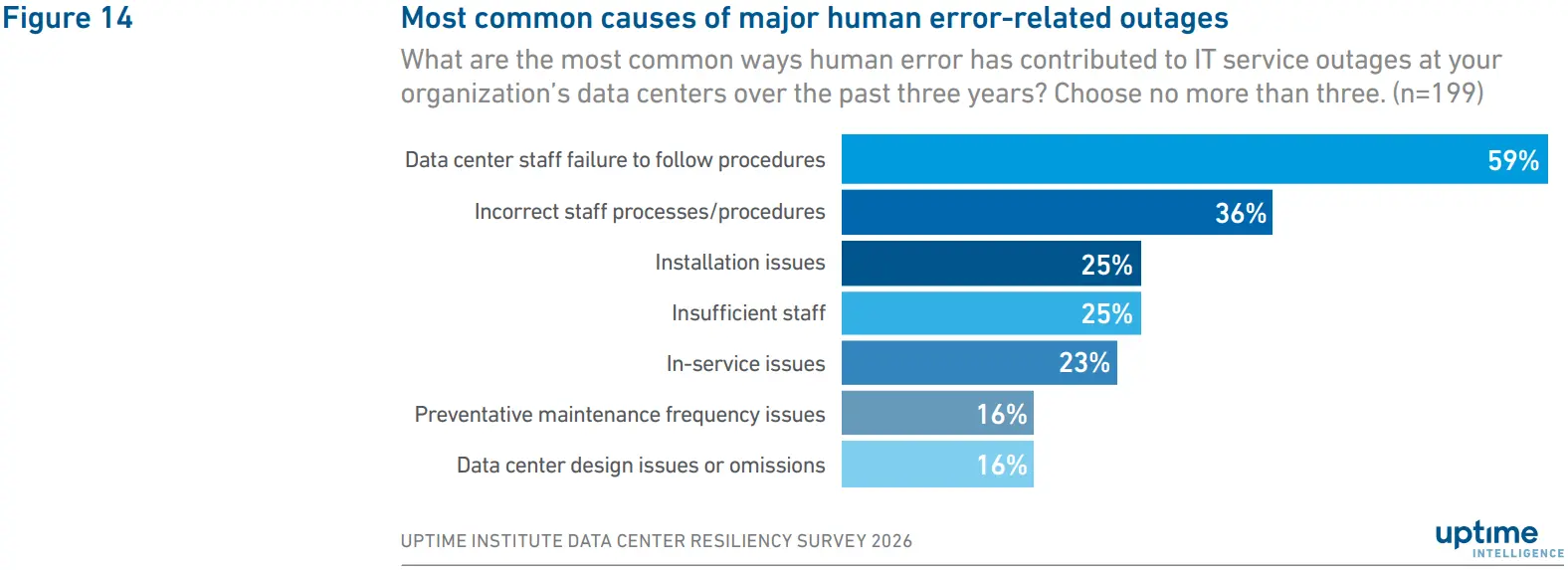
Yet, human error remains one of the leading causes of outages and unplanned downtime. The Uptime Institute's 2026 report found that between two-thirds and four-fifths of major IT and data center outages involve some element of human error.
Mark Lundregan, Senior Data Center Sales Leader, Mission Critical at ABM, says these mistakes are not due to a lack of technical ability. Rather, it is a lack of understanding about the data center environment itself.
In a data center, Lundregan says, procedures govern everything, from how work is planned and documented to how equipment is accessed and maintained. There are approvals, customer coordination requirements, and operational safeguards that must be followed before work even begins.
A generalist provider unfamiliar with that environment may focus only on completing the task, while specialists understand the broader operational context. Or in a high-pressure moment, a lack of proper training or clear procedures makes mistakes almost inevitable. Someone might open the wrong breaker, perform a task in the wrong sequence, or overlook a critical dependency.
Life sciences: where compliance is life or death
Research labs and life sciences facilities are, first and foremost, regulatory environments. Chad Walters, Platform Operations Manager – National, Life Sciences at ABM, says that in recent years, regulatory scrutiny has increased across the industry. Inspectors are looking much deeper into manufacturing processes, ingredients, and quality systems.
As a result, life sciences facilities are under more pressure than ever to maintain compliance, document processes correctly, and execute procedures consistently. The margin for operational error is effectively zero.
When errors do happen, the most common mistake is a deviation or nonconformance: when someone fails to follow an established procedure. Even minor deviations can be expensive. For instance, if someone forgets to take out the trash at the end of the day, this triggers an investigation: interviews, documentation reviews, root cause analysis, and corrective actions. On average, a minor deviation can require approximately 22 hours of investigation work and cost around $20,000 to resolve, says Walters.
Major deviations can be far more serious, leading to recalls, regulatory action, manufacturing shutdowns, or even tainted products reaching customers. The financial impact can reach hundreds of millions of dollars depending on the product involved. There are also reputational risks and public health implications.
As a result, record-keeping is a non-negotiable skill for life sciences professionals. Logbooks, records, and compliance documentation must be accurate and completed correctly every day.
A large life sciences facility in Houston was experiencing documentation and compliance issues. Investigations were becoming increasingly difficult because employees had not been properly trained in technical writing, root cause analysis, or regulatory documentation. The investigations consumed significant time and resources without effectively addressing the underlying issues, says Walters.
Specialized knowledge made a major difference. Understanding how to document events correctly, conduct root cause analysis, and implement effective corrective and preventive actions (CAPAs) helped prevent ongoing compliance challenges and reduce the burden on investigation teams.
Aviation: where every minute has financial impact
One word has defined the airline industry over the last decade: volatility. From peak performance in 2016, to the complete industry shutdown during 2020, to a strong recovery, airlines and airports are now committed to a total refresh.
Christopher Dohne, Vice President of Sales, Aviation at ABM, says that today airports and airlines are focused on the passenger experience. Airports are investing in customer satisfaction and recognition awards, actively pursuing customer experience accolades. Airlines are expanding premium economy offerings and even introducing new business-class concepts. At the same time, industry disruptions, such as airline bankruptcies, create opportunities for competitors to attract new customers.
With this background, the challenge for service providers is to deliver the right staffing levels, training, operational philosophy, and industry experience. Generalist service providers may be able to meet staffing needs, but they will not have the training, operational philosophy, and industry experience. And this lack of depth of knowledge has a significant economic impact.
After safety, time is one of the most important priorities in aviation. Small delays can quickly ripple throughout an entire operation, said Dohne. In many industries, being 15 minutes late might be an inconvenience. In aviation, a cleaning crew arriving 15 minutes late can have significant operational consequences. Airlines make money when aircraft are in the air, not sitting on the ground. Every minute matters. Delays can affect service-level agreements, disrupt schedules, and create cascading operational challenges.
How specialization solves across all three environments
The environments described in this article are not edge cases. They represent a growing share of the built world: the facilities that power the digital economy, protect patients, and manufacture the chips that everything else runs on.
Training
Specialized service delivery in data centers starts with training. In ABM’s power services for data centers, technicians can earn NETA certifications that establish standardized testing methodologies, tools, and procedures. It is not simply about getting the job done. It is about completing the work according to a rigorous industry standard.
This approach empowers teams to identify issues before they become problems. “Before major maintenance activities or upgrades, we develop detailed Methods of Procedure (MOPs) that identify every step involved, potential risks, and contingency plans,” says Lundregan. “In some cases, while developing those procedures, we've identified risks or gaps that the customer hadn't previously recognized. Other times, we've reviewed projects such as capacity upgrades and identified upstream or downstream impacts that weren't part of the original scope.”
GMP training is foundational in life sciences. And, Walters says, so making sure the team receives site-specific training to understand the facility's requirements. Generalized providers often skip this step and move people directly into a life sciences environment. That is where problems occur.
Governance and partnership
Specialized providers operate as an extension of a client's organization. These providers are not simply providing labor; they are helping protect compliance, product quality, and operational continuity.
Dohne says that orientation contributes to deeper client relationships. “We invest heavily in helping new employees understand what to expect. Airports are complex, fast-moving environments with many interconnected operations,” he said. “Strong orientation improves employee retention because it sets realistic expectations from day one. Rather than overselling the role, we provide a clear picture of the environment so employees are prepared for success.”
Long-term partnerships help facilities mitigate the risks (and costs) of high turnover. Finding highly skilled technical talent can be extremely difficult. A specialist will be focused on recruiting people with very specific skill sets. Once they are part of the organization, the specialist provides a clear development path that allows each team member to continue growing.
For instance, within ABM’s Mission Critical Services, we maintain structured career paths and training programs, says Lundregan. Employees progress through levels of Critical Facility Technician (CFT) training, with increasing responsibility tied to demonstrated skills and experience. An entry-level technician would not be assigned to high-risk electrical switching activities at a data center. Those responsibilities are reserved for more advanced technicians who have completed the appropriate training and gained the necessary experience.
Technology
Generalists can staff a contract, but they do not always bring the institutional-level resources of a specialist. In aviation, ABM’s specialized teams use ABM Connect to ensure accountability, visibility, and responsiveness. It allows us to understand where employees are, respond quickly to issues, and provide real-time visibility to customers.
ABM Connect for Life Sciences provides real-time compliance. Traceable cleaning and disinfection records, equipment maintenance history, and calibration logs can be tracked and saved in ABM Connect. With integrated reporting, service activity is captured in real time, enabling supervisors and facility leaders to gain visibility into work order status, monitor progress, and view response times and quality performance in real time. This real-time information helps life sciences facilities improve the efficiency, safety, and compliance of their daily operations.
Specialist providers are also better equipped to meet sustainability imperatives. The aviation industry is focused on electrification and reducing environmental impact. We work closely with suppliers to ensure they adhere to sustainability standards.
Conclusion
At first glance, data centers, life sciences facilities, and airports appear to have little in common. One powers the digital economy, one develops life-saving therapies, and one moves millions of people around the world. Yet all three operate under the same reality: the cost of failure has grown exponentially.
In these environments, mistakes rarely stay contained. A missed procedure in a cleanroom can trigger a product recall. A small error during data center maintenance can disrupt critical services. A brief delay on an airport ramp can ripple through an entire flight network. The consequences are financial, operational, regulatory, and increasingly reputational.
That shift is changing what facility owners expect from their service partners. The conversation is moving beyond staffing levels and contract costs toward questions of expertise, governance, training, and risk management. Organizations need partners who understand not only how to perform a task, but how that task fits into a larger operational system.
As critical environments become more complex, the specialization differentiator is the difference between a provider that completes the work and a partner that protects the operation.
Abm Contributors




.webp)



%20(1).webp)