Connecting people and spaces: Where facility bets are being placed next (part I)


.svg)
Key Takeaways
Insights from Angela Culver, VP of ABM Performance Solutions, and Kayla Oliver, VP of Product & Innovation, suggest several shifts are redefining how organizations think about facilities, experience, and the workplace.
Transcript
It is almost impossible to reduce the facilities profession to a singular function.
For many facility leaders whose operations hinge on high-tech equipment and machinery, recruiting engineers with specialized degrees and backgrounds—sometimes within days—has become a central part of the job.
For others, the work has expanded into operationalizing artificial intelligence—a balancing act that requires integrating advanced analytics into existing systems under live conditions.3
This ability to deliver non-traditional support at scale, plus a greater understanding of how buildings influence core business activities, has given facility professionals more prominence at the intersection of critical functions. As a result, leadership teams have begun budgeting out facility director-level salaries to the tune of a quarter-million dollars a year.
But elevated standing comes with elevated expectations.
Decision-makers are now asking:
- Can my facility partner deploy technology that enhances performance?
- Can they make the built environment part of our talent strategy?
- More importantly, can our infrastructure do both at once?
Often, the answers lie in workplace experience solutions.
From workplace aesthetics to experience driven strategy
For a long time, experience solutions occupied a specific and somewhat modest lane in the integrated facility services (IFS) ecosystem. Considered the finishing touch, these offerings were primarily associated with office beautification projects, front desk concierge services, and event coordination.4
Today, aesthetic and service-based elements have become pivotal. When ABM modernized an autonomous vehicle company’s Silicon Valley headquarters, the project visually refreshed the workspace, established a stronger brand identity, and helped the company stand out in one of the world’s most competitive talent markets.
At the same time, enhancements that improve optics alone do little to address the deeper recalibration underway across many organizations. Employees are increasingly weighing the value of their work against what the workplace tangibly delivers in return.1
If experience is to meaningfully influence performance and retention, it must move from the edge of the organization to the center of its daily functions.
Experience as an embedded system
Experience elements can be integrated within every facility service that a building carries. They can expand or contract as operational needs evolve and operate across multiple dimensions of the workplace ecosystem.
That elasticity matters for two reasons.
- Demand Volatility
Most U.S. cities continue to hover around 30-40% of pre-pandemic occupancy, even amid formal return-to-office (RTO) mandates.2 Peak days compress usage into shorter windows. Certain zones surge while others sit empty. Facilities must perform at a high level against inconsistent demand and shifting patterns of use.
Experience embedded within core services allows operations to scale without compromising quality.
- Perception Reset
The returning workforce isn’t homogenous. Hybrid schedules mean many employees interact with the workplace intermittently, reengaging with systems and amenities they haven’t used in years.
Institutional familiarity has eroded. First impressions are forming again, and small operational signals like cleanliness, responsiveness, and front-of-house interactions carry disproportionate weight.5
That experience plays out differently depending on who’s in the building, where they are, and what they need.
How facility roles shape workplace experience
Experience is activated through people.
- Cleaners who deliver care based on up-to-the-minute occupancy levels, directly addressing one of employees’ most immediate concerns when returning to shared spaces5
- Engineers who safeguard comfort through proactive system intelligence rather than reactive response
- Mailrooms that eliminate friction through intelligent routing workflows
- Visible security teams who streamline access across distributed portfolios, named by U.S. workers as a key factor in feeling safe, supported, and professionally managed in the workplace5
By adapting service models to specific contexts, whether in manufacturing, healthcare, aviation, or corporate settings, every role can contribute to a better occupant experience. The underlying intent stays the same: reduce friction, build confidence, make the environment feel managed.
Designing seamless occupant journeys across the workplace
Experience unfolds across many interconnected moments. The built environment either removes or compounds friction.
A smooth arrival sequence, intuitive wayfinding, and a visible security presence reinforce confidence and comfort, which is particularly important for employees recalibrating their relationship with in-person work.1
During the day, the focus shifts to reducing friction. Easily located spaces, accessible and technology-ready meeting rooms, and amenities that integrate seamlessly into daily workflows all help reduce the small but cumulative frustrations that can erode the value of being in the office.
Delivering consistent experience in daily operations
Ultimately, experience comes down to the everyday.
Badge access that functions consistently across locations, clear building navigation, and coordinated support for employees across different regions. These things matter more than most organizations account for.
While most workers desire digital access to services, nearly 6 in 10 still say it’s equally important to have a facilities professional they can interact with, highlighting the need for an approach that is equal parts tech-enabled and human-centric.1
Getting that balance right across every touchpoint, location, and occupant interaction requires something even the best-intentioned service model can’t provide: a single point of control.
That’s where technology comes in.
Using integrated facility technology to scale experience
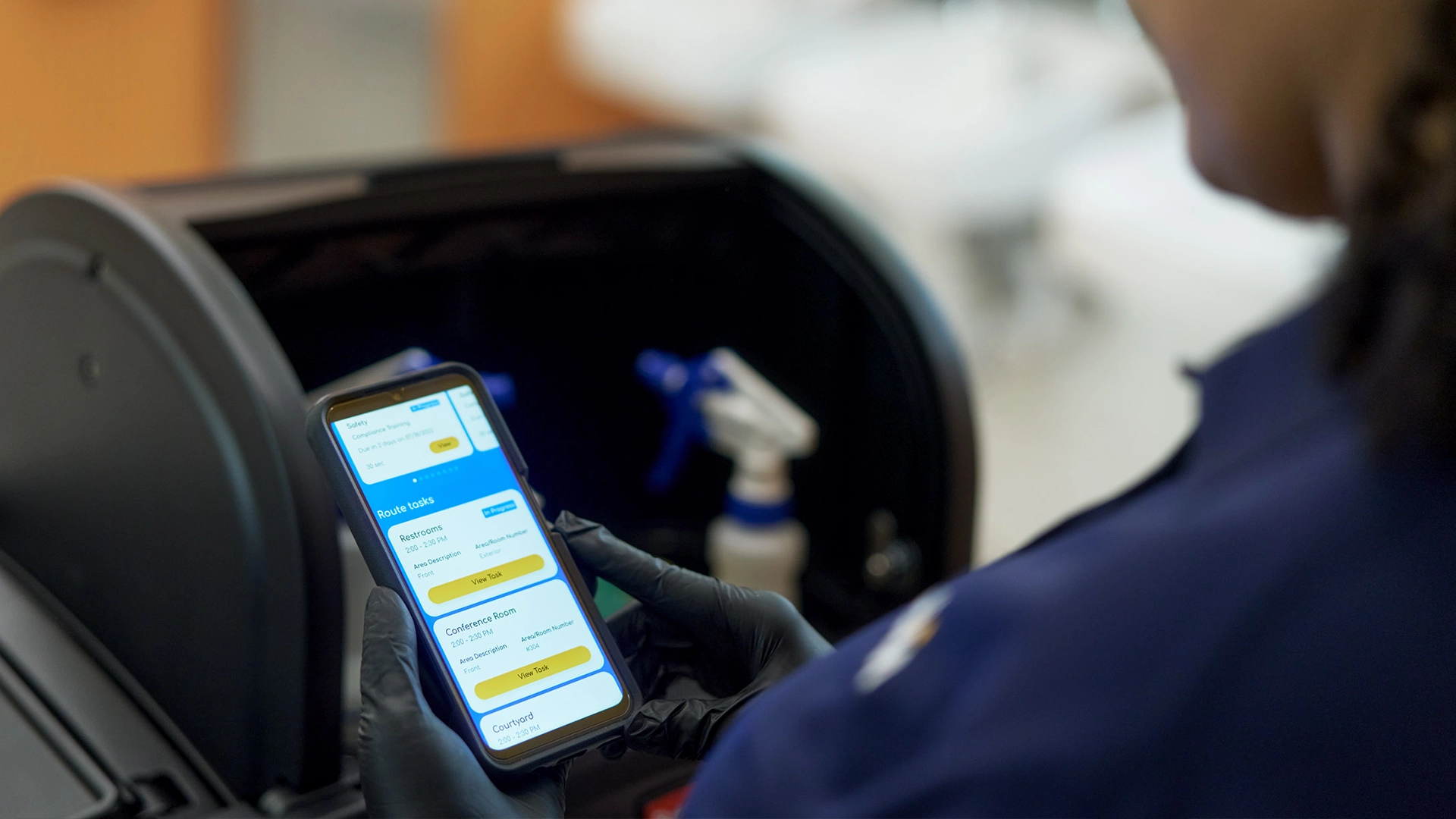
None of this coordination happens without good data. The facility needs to be generating usable intelligence, which requires a platform layer capable of consolidating building systems, maintenance workflows, quality tracking, and occupancy metrics into something facilities teams can act on.
Technology turns a cleaning team’s instincts into a data driven routing model. It shifts engineering from reactive response to proactive system intelligence, which can reduce emergency repair costs by 40% and significantly extend equipment life.5
That same integration layer also makes the front end simplicity of a single app—one place to reserve a desk, submit a work order, adjust temperature, and access the building—possible in the first place.
Technology decisions are never one-size-fits-all. The most effective deployments prioritize solutions that deliver immediate, measurable returns rather than theoretical efficiencies. Rather than basing decisions on sophistication level, workplace leaders should start by asking, “What does ROI look like for my building, workforce, and long-term plan?”
For organizations with asset inventory, building automation infrastructure, and strategic appetite for full integration, technology pays for itself in productivity gains, capital planning intelligence, and in the experience it quietly enables.5
For others, the work is in finding the right combination of technology, service, and human presence, and ensuring every workplace solution earns its place.
Why experience is now a competitive advantage across industries
The common thread across every sector, workforce, and building type comes down to one question: why do people choose to be here?
Compensation still matters, but far less than many assume. One study found that nearly 90% of workers would give up part of their salary in exchange for a more personalized experience.¹ Ultimately, choosing one organization over another—or deciding to come in on a day when attendance is optional—depends on something harder to quantify: what does it feel like to be here?
Today, the single biggest force accelerating investment in workplace experience solutions is the return to office. Mandates can drive initial attendance, but only experience can sustain engagement. Building the operational infrastructure that makes that experience consistent, seamless, and scalable is where the real work begins.
In part two, we explore how technology makes experience repeatable, how organizations can translate strategy into execution, and which leaders are best positioned to turn experience driven infrastructure into a measurable advantage.









.webp)