Connecting people and spaces: Designing for experience (part II)


.svg)
Key Takeaways
Angela Culver, VP of ABM Performance Solutions, and Kayla Oliver, VP of Product & Innovation, see the path to experience at scale resting on a clear set of operational foundations.
Transcript
A people‑centric workplace experience is only as responsive as the data behind it. From occupancy‑based cleaning to predictive engineering, embedded services rely on signals that only a properly configured building can produce.
Transforming isolated services into a responsive environment
Consolidating building, quality, and occupancy data into one dashboard makes it easier to deliver a consistent and high quality workplace experience at scale. Eliminating fragmented (and often paper based) record keeping, this digital infrastructure forms the foundation upon which every facility service runs.
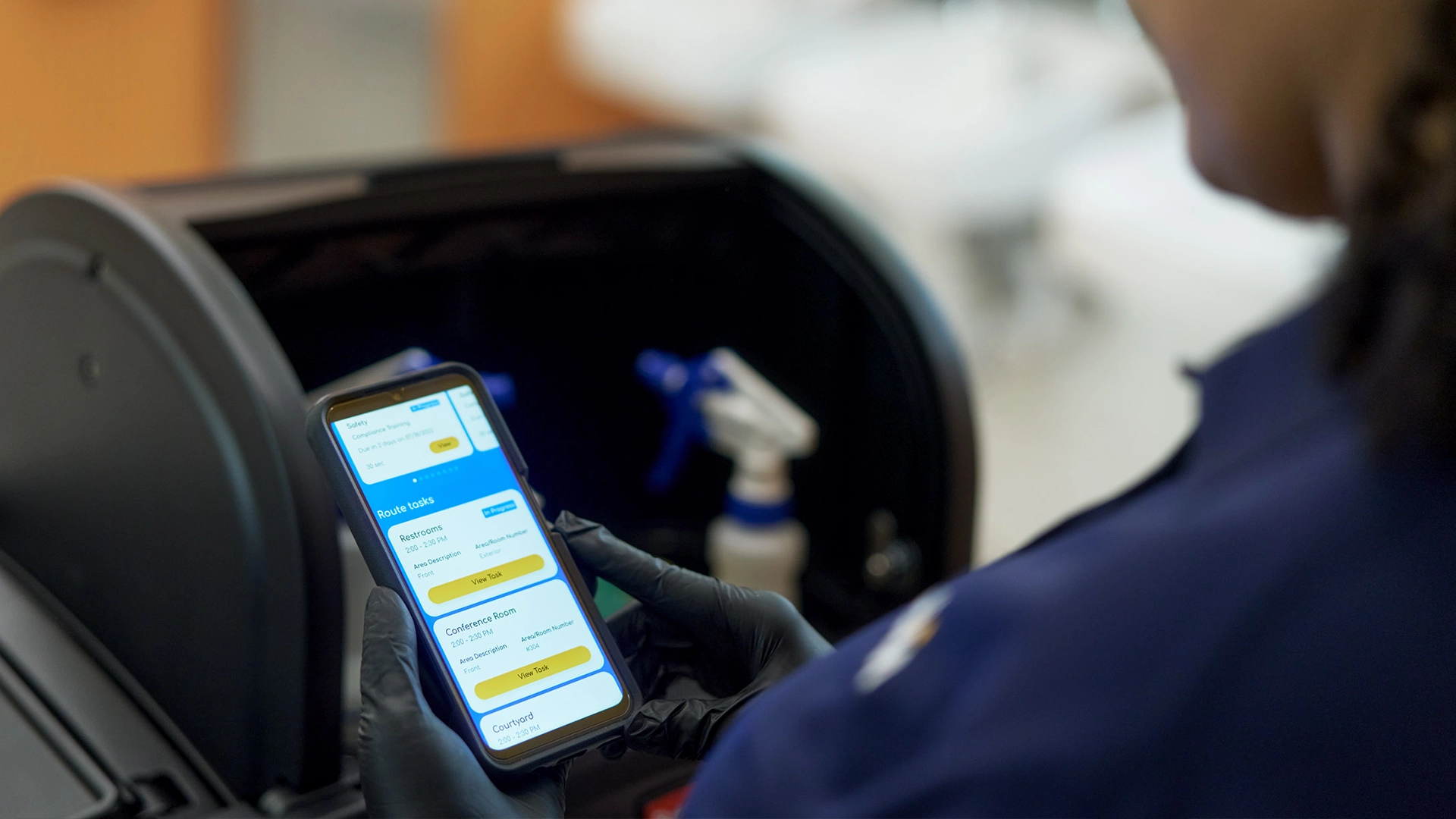
When coordinated through a frontline team-member app, predictive maintenance can be one of the most visible ways this model creates value. Real-time monitoring of major building systems routes alerts directly to technicians, enabling intervention before a problem becomes a complaint or a compliance issue.
In high stakes environments like labs, research facilities, and healthcare settings, this responsiveness maintains environmental stability and shields operations from deviations.
Using occupancy data to drive service delivery
When cleaning frequency, staffing schedules, and route density adjust to actual demand, the efficiency gains are significant. Usage-based service delivery has demonstrated cleaning cost reductions of 20 to 40 percent, without diminishing perceived service quality.1
Demand-based cleaning programs that leverage occupancy sensors and integrated CMMS platforms consistently report double-digit labor efficiencies, while improving occupant satisfaction scores in Class A office and healthcare properties.2
In high-traffic environments like sports arenas, airports, and hospitals, the stakes are higher still. The occupant experience is shaped by moment-to-moment reliability where even minor lapses in maintenance erode confidence.
ROI first, sophistication second
Not every facility needs every solution. The most effective deployments prioritize technologies that deliver immediate, measurable returns over theoretical efficiencies that risk stalling during implementation.
Engineering News-Record has similarly reported that phased smart-building investments—particularly those anchored in automation and analytics rather than standalone apps—deliver faster payback periods and higher executive buy-in than large, all-at-once digital retrofits.3
For organizations with the necessary asset inventory, building automation infrastructure, and strategic commitment, the technology pays for itself through productivity gains, capital planning intelligence, and a stronger workplace experience.
Across all successful use cases, adoption calibrates to what each environment can absorb and utilize effectively.
See the space, talk to the people
Every engagement begins the same way: see the space, then talk to the people in it. Before any solution is designed or proposed, the priority is understanding what’s working, what isn’t, and what the people using the space truly need.
Sometimes, the answer is comprehensive programs such as curated events, mapped employee journeys, sensor technology, or app integration. Other times, it’s as simple as furnishing a quiet area with good lighting for focused work.
ABM’s discovery process distinguishes between these needs and ensures every solution earns its place.
Why sustaining experience requires ongoing attention
Once a solution is live, the most valuable input comes from the people using it. An offhand comment about a room or a request that reveals a shortfall in the user journey provides the raw material for continuous refinement but only if someone is actively paying attention.
Regular reviews from people with fresh perspective—whether an ABM team member, an operations leader, a frontline technician, or even the client or occupants themselves—create a built in mechanism to keep the experience from going stale.
When a technology has proven its value elsewhere, those teams can introduce it proactively. This forward looking function becomes especially important as organizations face pressure to justify new investments in a cost conscious environment.¹
Who experience solutions serves
Organizations that gain the most from experience solutions typically share three traits.
- On the building side, they have an existing asset inventory, a building automation system, and critical infrastructure already generating meaningful data.
- Organizationally, they demonstrate genuine financial commitment to experience as a strategic priority versus a line item to be cut when budgets tighten. Without that commitment, conversations default to no-cost options, which have a limited ceiling.
- At the market level, the solution delivers the most value where the workforce is distributed or returning to the office, and where talent competition makes the workplace environment a real differentiator.
That last condition is the primary driver in the current market. Talent pressure spans every sector: healthcare, technology, higher education, finance. The decision to join one organization over another, or to come in voluntarily on a random weekday, increasingly depends on what it feels like to be working there.
According to ABM research, 93 percent of U.S. workers say a strong office culture matters to them, yet only 65 percent rate their current culture as positive.⁴
That gap is where experience strategy lives.
Questions every leader should be asking
- Data Readiness: Does my building automation system (BAS) generate meaningful data, or is it just running in the background?
- Friction Audit: Where are the cumulative frustrations in our building? (e.g., faulty room booking, slow badge access, confusing wayfinding).
- Service Agility: Are we cleaning and maintaining based on fixed schedules (M-F, 9-5) or based on actual usage and occupancy data?
- Strategic Alignment: Is our C-suite viewing IFS as a cost center to be minimized, or as a retention tool for top talent?
First steps to implement an experience solutions strategy
- Map the Journey: Walk your facility as if you were a new hire. Note every friction point from the parking lot to the desk.
- Survey the Occupants: Ask specifically about the barriers to productivity they face in the physical office.
- Audit the Tech Stack: Determine if your current platform layer can support predictive maintenance and smart routing.
- Start Small: Identify one high-traffic area (lobby or cafeteria) to pilot an embedded experience model before scaling.
Experiencing is believing
Facility leaders have embedded experience into the built environment for decades. But RTO mandates changed the stakes, pushing teams to deliver workplaces that feel purposeful, intuitive, and worth the commute.
Many organizations haven’t caught up. One global survey found that 63 percent of employees returned to settings that look and operate exactly as they did before the pandemic—revealing a disconnect between what people need and what their jobs provide.⁴
More than a layout refresh or another workplace app, meeting this moment takes operational readiness, data enabled infrastructure, and an experience strategy that turns the workplace into a force multiplier. We now know that when those elements align, businesses realize gains in retention, productivity, and presence.
For organizations navigating a shifting workforce or competing for top talent, this moment offers a rare chance to shape the environment where the future of work will unfold.












%20(1).webp)