Five questions to help automotive facility leaders improve efficiency


Key Takeaways
- Look beyond contract cost: Facility organizations managing a long tail of specialty vendors are absorbing avoidable costs and complexity. Partners with a single contract and a single point of accountability that self-perform multiple services reduce that burden.
- Match resources to demand: Sensor-driven workflows and live dashboards replace fixed schedules and quarterly reporting with continuous, real-time visibility. Labor follows demand, not habit.
- Account for the cost of turnover: Structured investment in frontline staff reduces the turnover that quietly erodes operational quality. Facilities that treat their workforce as a long-term asset consistently outperform those that do not.
Transcript
“How do we get more efficient without giving something up?” That question comes up in nearly every conversation with automotive facility leaders. When budgets are flat and expectations keep growing, the real challenge is finding savings while meeting the demands of your facility.
Would a lower service cost leave your team with more coordination work? Could reducing maintenance spend increase your exposure to downtime? Are there places where resources could work harder without asking people to do more?
Those trade-offs depend on your facility. A final assembly floor, a battery manufacturing line, and an advanced testing environment each bring different demands. An approach that saves money in one setting may introduce risk in another.
Based on ABM’s extensive work supporting OEM and tier-one automotive facilities across the country, these five questions can help you explore where efficiency gains make sense—and what you need to protect along the way.
1. How much time do we spend managing vendors?
Vendor sprawl is one of the most common and underappreciated problems in automotive facility management. It usually develops gradually: a separate provider for janitorial, another for HVAC, another for electrical work, and additional contracts for other building services. By the time someone maps out the full vendor list, the site is managing a dozen or more relationships, each with its own scheduling, billing, safety requirements, and on-site coordination needs. For a team whose primary job is keeping production running, that overhead is a real cost, even if it does not appear as a line item. “Every vendor that comes on site has to be checked in, verified for safety compliance, and sometimes escorted around the property,” says Mark Stillman, Regional Account Manager at ABM. “And that’s before you even get to billing.”
An alternative is self-performance: a partner that directly employs and manages the people doing the work, rather than subcontracting and layering a management fee on top. Self-performance means one point of accountability for quality, safety, and compliance. It means the people on your floor report to the same leadership structure, operate under the same standards, and can be redirected quickly when priorities shift.
Facility leaders need to ask: Is my partner directly performing this work, or managing a subcontractor? And where does accountability actually sit when something goes wrong?
Strategic insight: Self-performing partners reduce vendor overhead to a single contract and a single point of accountability. For facilities where production continuity is the priority, that simplification has real operational value.
2. How can our service model respond better to actual demand?
Most facility operations were built around fixed schedules. Clean this space daily. Check this restroom every two hours. Run this inspection on the first of every month. That approach creates a kind of operational predictability, but it does not necessarily put resources where they are needed.
But there is now a shift toward demand-driven operations. Sensors and connected building systems can tell you which spaces are being used, how heavily, and when. If a conference room has been vacant all day, sending a technician to service it again is a wasted effort. If a high-traffic area on the production floor needs attention, you want to know in real time, not at the next scheduled visit.
This matters beyond just cleaning. Work order management, preventive maintenance scheduling, and supply restocking all benefit from the same logic: you act based on what is actually happening, not a calendar.
Visibility is the other piece. When clients ask about conditions at a site, the answer should be accessible immediately. “It’s not about pulling data into a PowerPoint and getting back to the client three days later,” notes Stillman. “The information is right there, in real time.”
Facility leaders need to ask: Does my current service model deploy labor based on actual usage data, or are we still operating on schedules set years ago?
Strategic insight: Demand-driven operations, supported by sensor data and live dashboards, reduce wasted labor and give leadership continuous visibility across every site.
3. What is our real exposure to unplanned equipment failure?
In automotive manufacturing, unplanned downtime is not an abstract risk. It’s a cost that compounds quickly through a stopped production line or a supply chain bottleneck. Preventive maintenance on a fixed schedule is table stakes at this point, but it leaves a meaningful gap. Equipment can fail between scheduled inspections, and the window between a developing problem and a breakdown can be short.
Predictive maintenance changes the equation. Sensors placed on critical equipment can monitor vibration patterns and temperature continuously. When readings begin trending outside of normal parameters, the system flags them before a failure occurs. The warning can give teams more time to schedule a repair before production is affected.
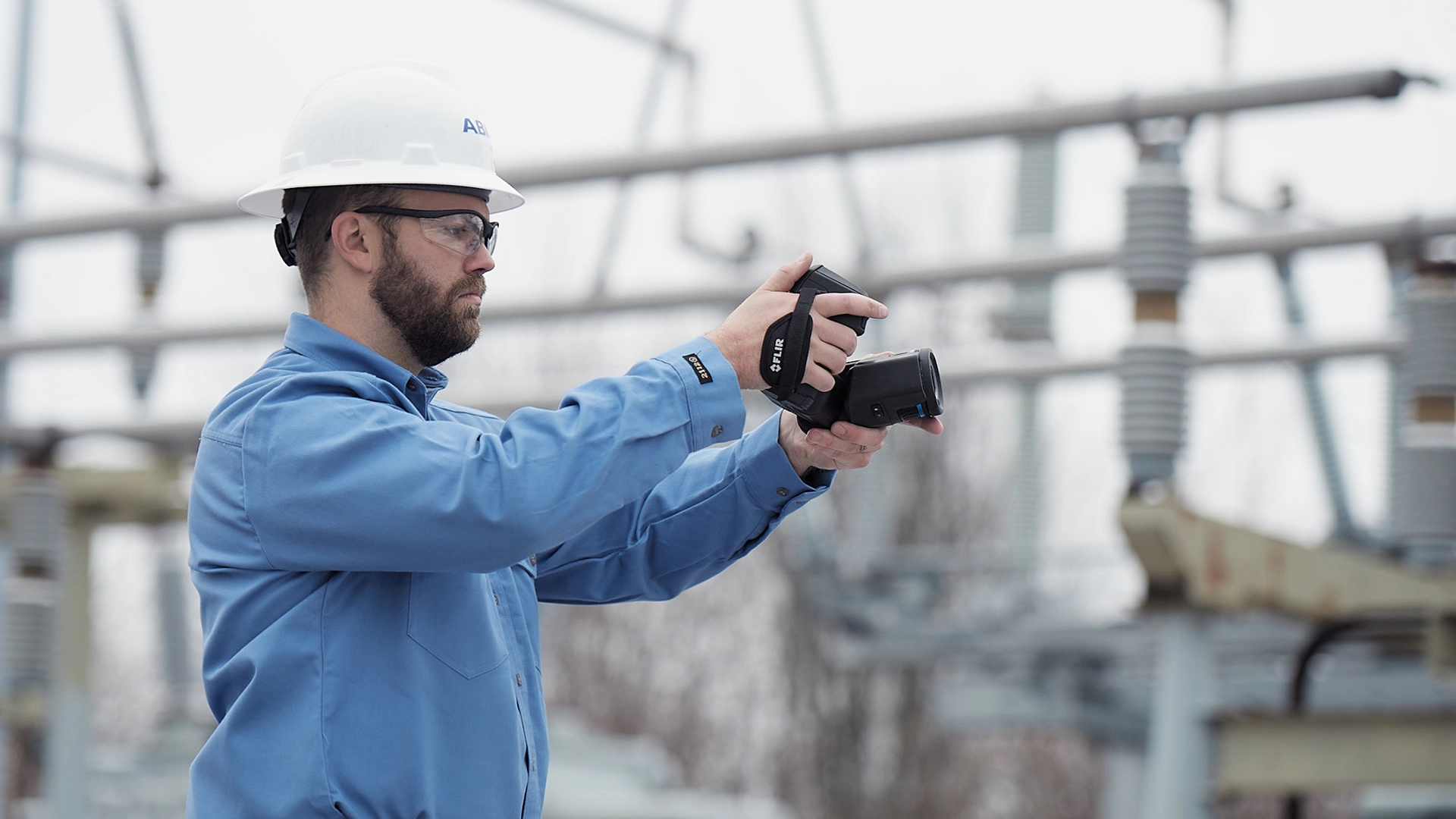
The same principle applies to electrical infrastructure. Continuous thermal monitoring of panel equipment can identify developing issues that traditional annual inspection cycles would miss. The shift from point-in-time to real-time inspection is one of the more impactful things a facility can do to reduce unplanned downtime.
Facility leaders need to ask: Are we catching equipment problems before they affect production, or are we responding after the fact?
Strategic insight: Continuous monitoring shifts the role of maintenance from scheduled inspections to real-time protection. For production environments, this approach can prevent unplanned downtime.
4. Does our facility partner actually understand our environment?
Automotive manufacturing environments vary significantly from one facility to the next, and even within the same campus. The solutions that work for a stamping operation are not the same as those for an advanced manufacturing line, and what works at one site may need significant modification at another. “Nothing’s cookie-cutter,” Stillman points out. “You have to tailor your solutions to every situation.”
For your team, the practical question is how much oversight a partner will need before they can work safely and effectively in your environment. Where is prior automotive experience essential, and what site-specific training would still be needed?
Facility leaders need to ask: Where has my partner worked in environments like ours, and can they demonstrate specific experience with the constraints we operate under?
Strategic insight: Automotive environments require partners with verified site-specific experience. The compliance requirements, chemical protocols, and safety standards differ across production zones in ways that a generalist approach cannot accommodate.
5. Are we treating our frontline workforce as a strategic asset?
When budgets are tight, it can be difficult to prioritize training. But turnover carries its own costs in recruiting, onboarding, and supervisory time. How do those costs compare with the investment needed to retain an experienced team?
When you work through the numbers, retaining a trained, capable frontline worker is significantly cheaper than replacing one. Yet many organizations continue to treat high turnover as an operational constant rather than a problem to solve.
Stillman adds, “When you invest the time to train frontline employees, they take that seriously. They appreciate knowing you’ve invested in them as team members.”
The people responsible for the cleanliness and safety of a facility are not a background function. When facility teams are well-trained, well-managed, and given the tools to do their jobs, it shows in the quality of the environment they maintain and in the safety record of the sites they work in.
Facility leaders need to ask: Is my facility partner investing in the development of frontline staff, or treating turnover as a cost of doing business?
Strategic insight: Training, clear processes, and mobile tools convert frontline staff into accountable, engaged team members.
Raising the standard for what facility management can deliver
The automotive industry is transforming rapidly, and the facilities supporting production have to transform with it. The opportunity is to move beyond reactive maintenance and think about facility management as something that is genuinely connected to production performance, rather than a separate overhead category to be managed down.
Delivering this level of sophistication requires the right model, the right technology, and the right investment in people. Organizations that align all three will find themselves with an operational foundation that supports growth rather than constraining it.