What LaGuardia's robotic dog says about automation readiness


.svg)
Key Takeaways
- Robotics readiness is a task-level decision, not a facility-level one: match the right robot to specific, repeatable, low-variability jobs.
- Three criteria determine automation fit: repeatability, variability tolerance, and low failure cost, with floor care and inspection the most mature use cases.
- Autonomous floor care delivers 37% average time savings, but robots still need human teams to open doors, clear obstacles, and act on alerts.
Transcript
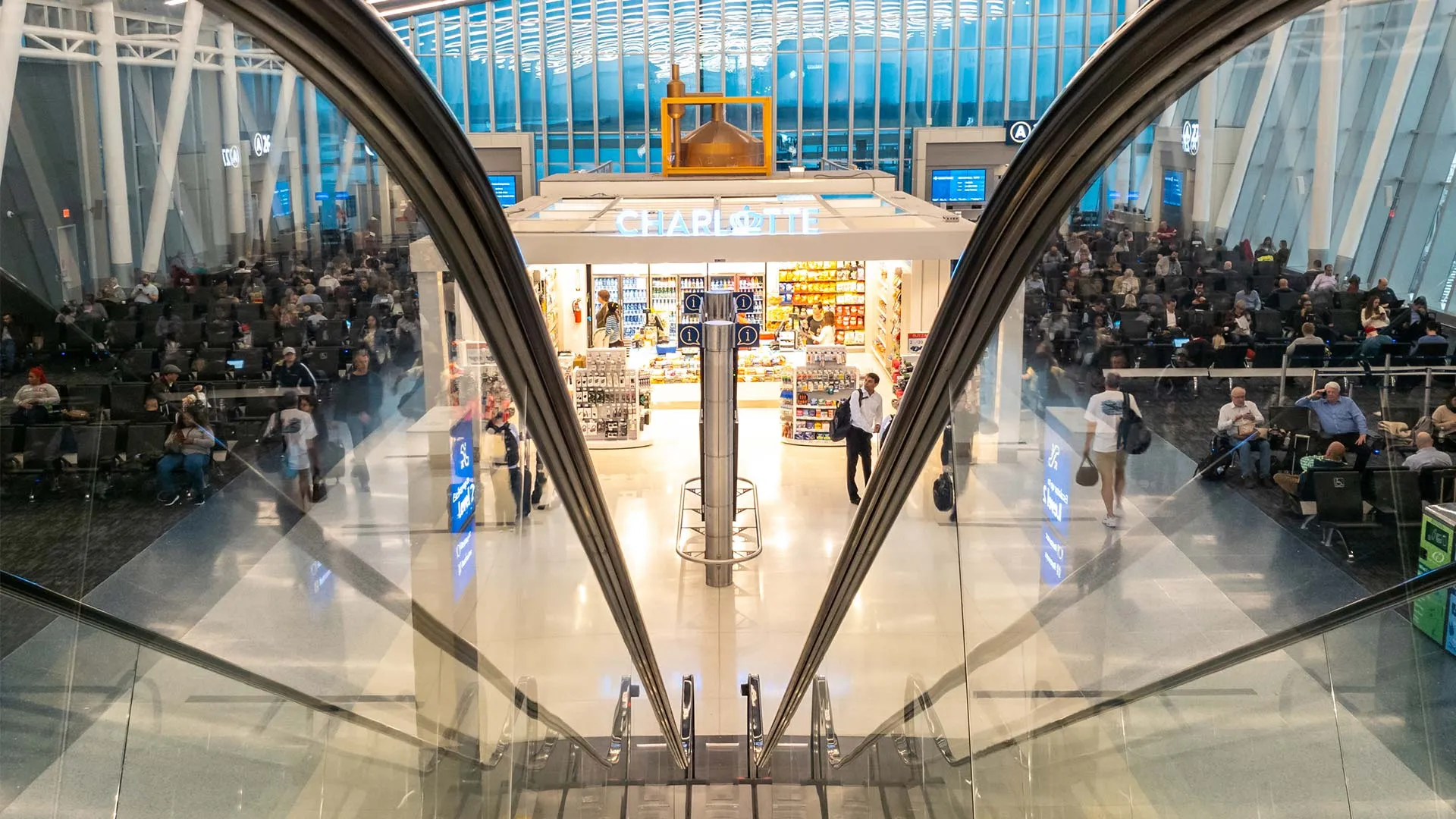
At LaGuardia Airport's Terminal B, a four-legged robot from Skild.ai patrols the concourse, inspecting facilities alongside ABM's staff. It moves through one of the busiest, most photographed terminals in the country, the first in North America to earn Skytrax's 5-star rating and a recent winner of World's Best New Airport Terminal.
A robot dog is a great story, and the kind of innovation that draws attention to facilities technology in a way spreadsheets never will. That attention is valuable. It is part of why ABM was named to Fast Company's 2026 list of the World's Most Innovative Companies, with its robotics and data work cited directly.
Part one of this series looked at the administrative side of AI readiness: how facility leaders move data from siloed to decision-ready and operational. Robotics and automation represent the physical version of that same process. Once a facility knows what needs to happen, the next question is whether a person, a machine, or some combination of the two should be the one doing it.
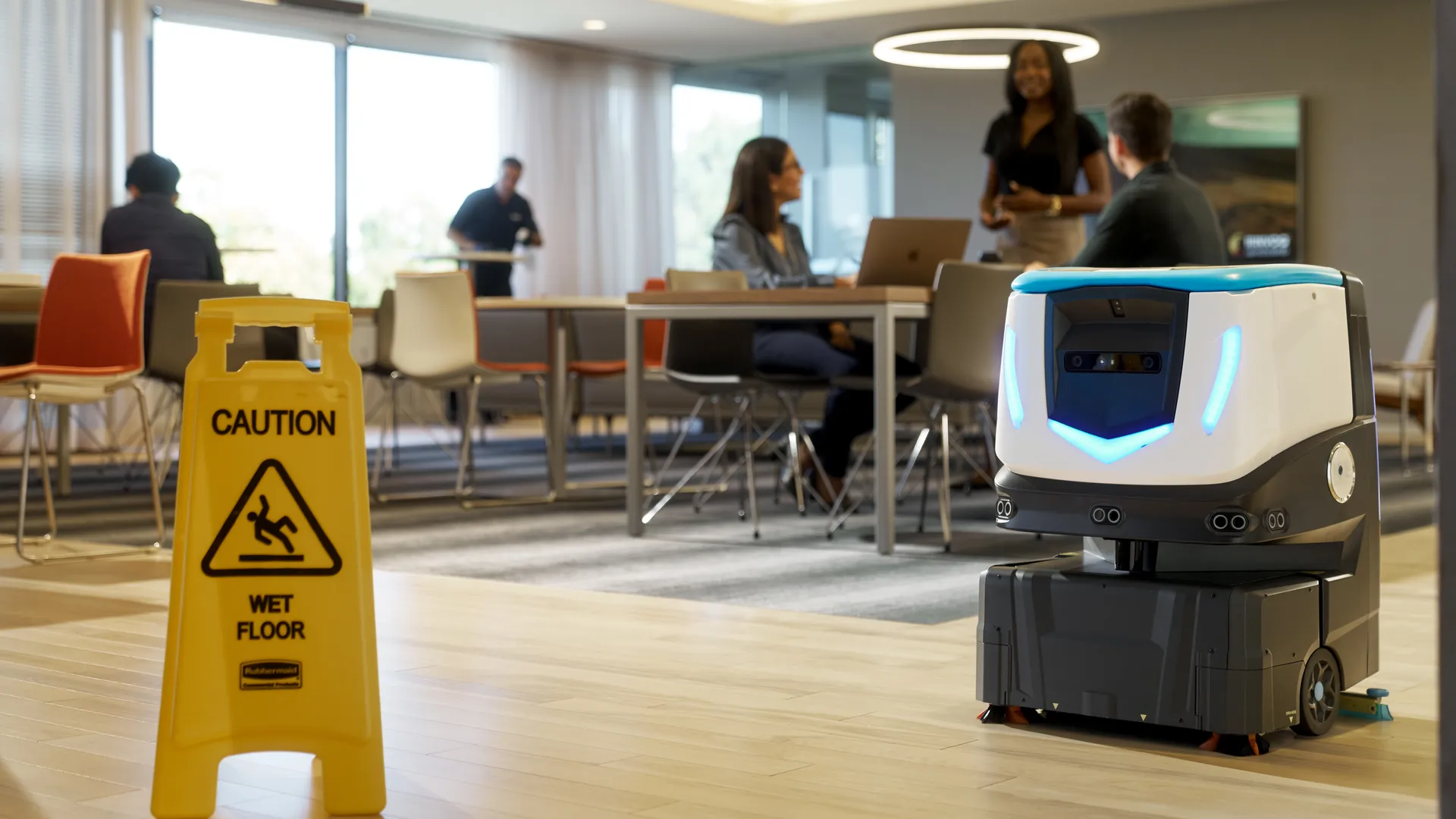
The robotic dog at LaGuardia is doing one job: inspection. An inspection robot is designed to gather data in environments that human inspectors cannot match, or at levels the human eye simply cannot reach. A few feet away, autonomous floor scrubbers are doing a different job entirely, running up to six hours on their own power and recharging without anyone managing the process. Two robots, two tasks, two separate answers to the question of how machines should be integrated into the workplace.
Facility leaders often fall into the trap of deciding whether they should deploy robots at all, as if robotics were a single decision. The more useful question sits at the task level: which specific, repeatable, low-variability jobs are actually ready for automation?
Robotics in facilities is fundamentally a matching problem. It is about pairing the right robot with the right job in the right environment, for a defined reason, not deploying technology because it photographs well.
How to spot an opportunity for robotics
Facility leaders do not need a robotics background to decide whether a task is ready for automation. Anjali Bivek, ABM's Senior Manager of Innovation, uses three criteria to determine if a task is the right fit for automation and/or robotics.
Repeatability
The task should look the same every time. “Robots work best today in highly repeatable tasks within a consistent space,” Bivek said. It is easier for the robot to do one thing well, and it also helps a facility’s quality scores. A robot delivers consistency shift after shift in a way a rotating human workforce cannot always match.
Variability tolerance
A robot does not need a perfectly predictable environment to operate. But it does need certain parameters to stay consistent. For example, Bivek notes that today’s robots still struggle with space constraints.
"The things that hold up deployment are fairly mundane. A robot cannot always go under a desk or a table, or move a chair out of the way," she said. "It is not opening doors. It is not getting on an elevator."
There’s a gap between what a robot can technically do and what a facility can reasonably expect it to handle. A robot’s independence is within a defined, bounded set of conditions. It is not able to navigate a building the same way a person can.
Failure cost
A good first deployment is one where mistakes are low stakes. If the robot misses a spot or has an off day, someone notices and fixes it easily, with no real harm done. That low risk matters because it gives a team room to trust the technology before scaling it up.
Once a task clears those three, where you deploy a robot first still matters. A robot that performs well across an open airport concourse may face very different conditions in an office filled with desks and chairs. A machine operating in public raises different questions than one operating behind the scenes. Even within the same facility, some areas may be better suited to robotics than others.
Bivek's advice is to sequence deployments by sensitivity and consider your facility's restrictions. A highly secure facility might have zero tolerance for cameras or new equipment in restricted areas, but its public lobby is a different environment entirely. A lobby is full of visitors, low on operational sensitivity, and a natural place to prove a new technology works before extending it anywhere more consequential.
For most facility managers considering this framework, one type of task might seem obvious. "The most mature use case of robotics is truly around floor care, both hard flooring and carpeting," Bivek said. Routine inspection is close behind. Both are high volume, well defined, and forgiving of an occasional miss. Together, these tasks cover a meaningful share of the physically repetitive work inside most facilities.
Start with a pilot
A demonstration shows what a robot is capable of doing, but not how it will perform on site. That’s why Bivek recommends typically recommends a pilot.
"We always have definitions of success before we start a pilot," Bivek said. "We talk about them with the client, the robot provider and our team. We define the KPIs we're going to measure, who's responsible, the stage gates, the acceptance criteria, and how we're going to raise and escalate issues."
The result is a defined period of active learning, not simply a robot placed onsite to see what happens.
Teams measure performance, document operational details and pay attention to the things that are difficult to discover in a demonstration: how often someone needs to intervene, what interrupts the robot's work, how it performs as conditions change and what employees working around it are seeing.
That evidence helps answer: What would it take for this technology to work here?
Robotics, AI, and automation in use
The LaGuardia pilot validates the limits of the framework outlined here. Floor care and inspection are exactly the two tasks the three criteria would predict: repeatable, tolerant of a changing environment within reasonable bounds, and forgiving of an occasional miss.
However, Terminal B is not a quiet back office or an empty lobby before opening hours. It is one of the busiest airports in the country, serving over 33 million passengers each year. ABM and LaGuardia Gateway Partners have worked together for years managing Terminal B's operations, well before a robot arrived. Deploying a robot dog in front of passengers was the result of years of collaboration and piloting innovative solutions.
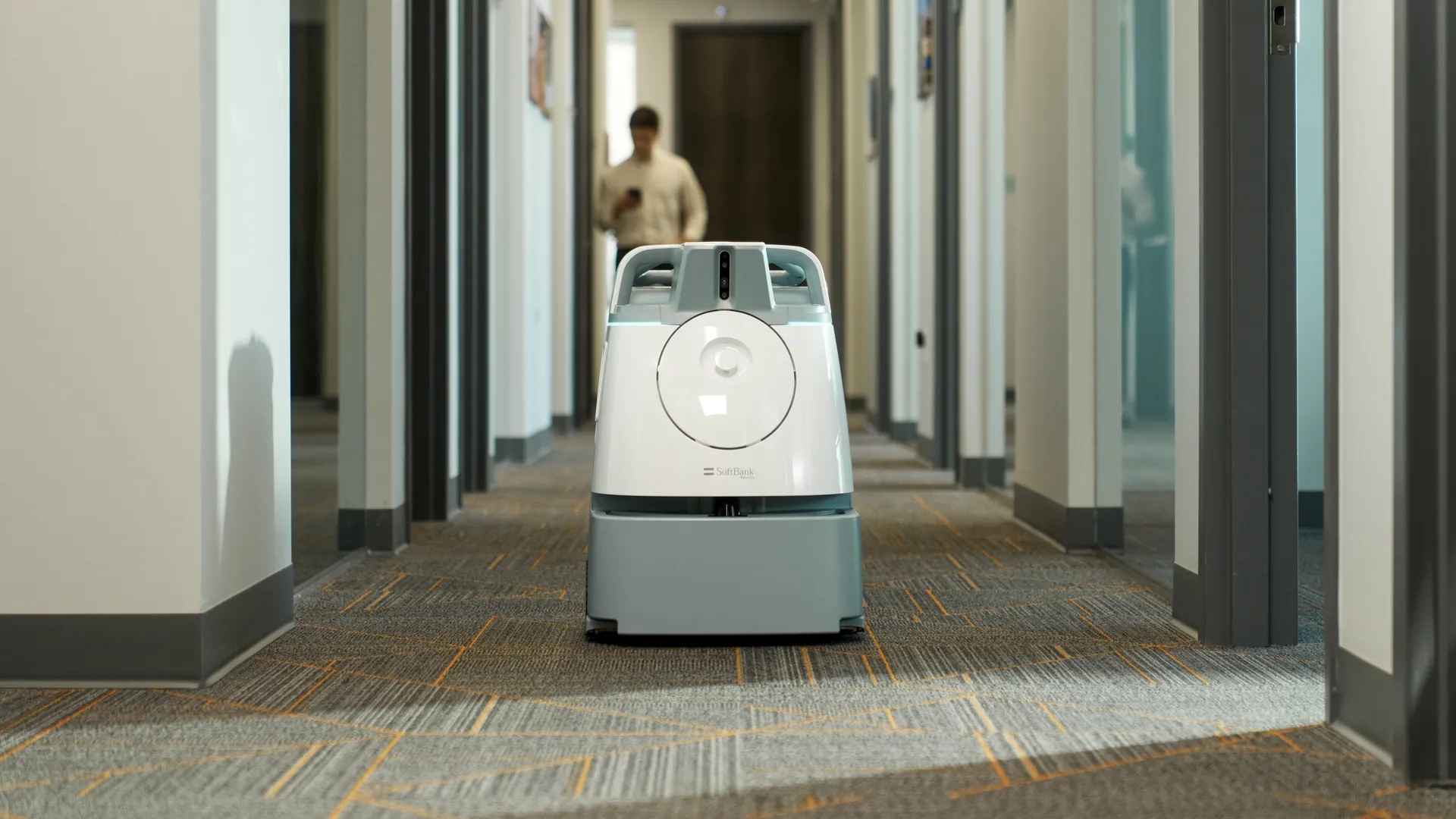
Part of that testing involved deploying autonomous floor scrubbers and vacuums. The scrubbers, in partnership with CenoBots, leverage advanced 3D LiDAR navigation and intelligent mapping to deliver consistent, high-quality floor cleaning. With the ability to run up to six hours autonomously, automatically recharge, and minimize downtime. Complementing the floor scrubbers, autonomous vacuums use advanced navigation and intelligent mapping to capture both fine dust and larger debris across high-traffic terminal areas.
Together, these robotics help ABM redeploy staff to higher-value guest-facing tasks while ensuring Terminal B continues to set the industry standard for cleanliness.
In restrooms, IoT-enabled sensors installed in paper towel dispensers track usage patterns in real time, feeding that data into ABM Connect to inform restocking and service scheduling instead of relying on a fixed cleaning calendar. On the waste side, ABM's partnership with Recycle Track Systems puts the Pello Sensor to work monitoring bin fill levels, tracking container locations, and flagging contamination, which improves service accuracy and diversion rates across client waste programs.
"Deploying a robot is not necessarily the hard part," Bivek said. "At ABM, we have created internal training, and deployment playbooks, as well as risk assessments." That groundwork is what makes projects successful.
What it looks like for teams to work alongside robots
Tasks that can be successfully automated are narrow in scope. Scrub the floor. Vacuum the terminal. Track fill levels in a trash bin. That narrowness is a feature, not a limitation; it draws a clear boundary around what robots are actually capable of, and where human talent is still necessary.
A study by ABM found that facility maintenance teams achieve 37% average time savings when compared to equivalent ride-on machine. Many of the autonomous robots still needed human intervention to open doors, remove obstacles, or reach areas the scrubber could not. While the machines save time, they are nowhere near replacing the teams that keep facilities running smoothly.
Likewise, sensors, dashboards, and predictive maintenance platforms create value only when someone knows what to do with what they surface. An alert that a bearing is showing early wear means little on its own. An engineer who has been trained to read that signal can log the work order, pull the part, and get the unit serviced before it becomes a bigger problem.
“For really the first time, tools like ABM Connect give facility teams visibility into the interconnected things that drive our servicing, letting us make smarter decisions and have smarter conversations with our frontline team members. Those decisions lead to better results for our clients. Our teams are more productive and performing the work at a higher quality than before,” said Manas Malik, Senior Product Manager, ABM Connect.
Training is what makes the entire equation come together. Frontline workers with the right training can use technology to cover more ground, catch problems earlier, and spend less of the day responding to failures that already happened. Far from replacing skilled technicians, the technology is what lets them work at the top of their expertise more of the time.
Looking forward
Bivek says two trends happening now. First, robots are starting to coordinate with each other. Second, existing categories are maturing before new ones open up.
"I see robotics heading toward more coordinated fleets. An inspection robot sees a problem and sends out a floor care bot to handle it, without a person routing the request in between," Bivek said.
At the same time, she expects the robots to improve on the tasks that already work before taking on entirely new work activities. "I think we are going to see a lot more maturity in what we call single use case robotics," she said. "Floor care is a single use case, but robots could also do bathroom cleaning. A handful of robotics companies are already building toilet and bowl scrubbing robots, tackling one of the least popular tasks in any facility.”
That technology isn’t quite market-ready, but Bivek is optimistic. As for facility leaders, Bivek's advice for where to start is the same regardless of what category of robot is on the table.
"What is the goal of the robot? Are you trying to augment labor? Are you trying to run on a leaner crew?" she said. "Start by asking, what is the site? What is the purpose of the site itself? Is it public? Is it private? Is it highly secure? Those are the kinds of things I would start thinking about first."
Her second piece of advice is just as practical: test before committing. "I would always recommend asking for a demo. Have the vendors come out and show you what their technology can do," she said. "You might learn something, like it does not fit where you need it to go, or the water hookups are way too far away. You are going to learn a lot through that process."
The emerging innovations in facility technology are exciting. But across the board, our experts recommend applying discipline before adoption. Define the goal, understand the environment, test before scaling, and let the fit between task and technology decide what comes next rather than the other way around.
.jpg)







%20(1).webp)
.webp)