Operational discipline is the foundation of sustainable facilities

.svg)
Key Takeaways
- Operational discipline first: Sustainable facility operations require standardized processes, workforce training, and measurable accountability, not sustainability goals alone.
- Proof is the new expectation: Clients no longer take commitments at face value. They want measurable, independently verified outcomes, from greenhouse gas inventories to management-system audits.
- ISSA CIMS validates the operating model, not just the outcome: The standard is layered, built on a documented cleaning and facility management foundation before sustainability criteria ever apply.
Transcript
Across industries, there’s an overwhelming consensus that sustainability needs to move from reporting to operations: from strategy to implementation. Yet, facility leaders face pressure to improve sustainability while maintaining operational efficiency, service quality, and workforce consistency. Sustainability initiatives struggle to move beyond corporate commitments amid these competing priorities.
There’s a mindset shift that needs to take place to achieve greater sustainable facility management. Successful leaders view sustainability not as a standalone program, but as an operational discipline.
Sustainability has moved from initiative to expectation
A decade ago, sustainability was often viewed as a differentiator. Today, it has become a baseline expectation.
Clients, investors, employees, and building occupants increasingly expect organizations to demonstrate environmental responsibility through procurement decisions, building certifications, workplace experience strategies, and long-term operating costs.
Despite existing reporting commitments, a gap remains between documentation and action. Many organizations begin their sustainability journey by establishing goals, yet far fewer establish the operational framework required to achieve them. The 2025 EY Global Action Barometer found that while 64% of companies have a climate plan, the majority of them either show no progress or are moving backward regarding prior commitments to transition plans.
Common challenges in facilities include:
- Inconsistent procedures across locations
- Limited frontline training
- Lack of documented quality assurance processes
- Fragmented reporting
- Difficulty verifying compliance in the field
These challenges become increasingly difficult as organizations grow across geographies, business units, and facility types. The result is a gap between corporate sustainability commitments and day-to-day operational reality.
The sustainability execution gap
Sustainability and operational excellence are aligned
Sustainable facility operations often depend on the same fundamentals that drive operational excellence: standardized processes,workforce training, quality assurance, and accountability. Without those foundations, sustainability goals often remain aspirations rather than measurable outcomes.
Consider the indirect and direct costs of using anold HVAC system. Maintenance and small fixes add up over time, not to mention the impact on employee productivity and occupant health, which have intangible costs. On the environmental side, an old HVAC system uses up to 50% more energy than current models, quietly adding carbon to your footprint with every cycle.

ABM clients cut their energy costs by 30% annually when they replace their HVAC.
This is just one example of how the sustainability strategies create a win-win for facility owners. The organizations making the greatest progress today are not necessarily setting more ambitious sustainability targets. They are building operational systems capable of delivering those targets consistently, every day.
What operationalized sustainability looks like
Operationalized sustainability occurs when environmental objectives are embedded into daily operations rather than managed as separate initiatives.
This requires alignment across four areas.
- Standardized operating procedures -
Especially in mission-critical environments, organizations need documented processes that define how work is performed, how compliance is maintained, and how environmental objectives are incorporated into daily operations. Standardization creates consistency; consistency delivers measurable outcomes. - Workforce training and education -
Even the strongest operational framework needs the right people to execute. Frontline teams need clear training on how sustainability standards translate into day-to-day responsibilities. Unifying facility, engineering, and infrastructure under one integrated approach reduces vendor fragmentation that complicates workforce readiness. Most ABM Performance Solutions customers see a 30% reduction in energy costs. - Quality assurance and verification -
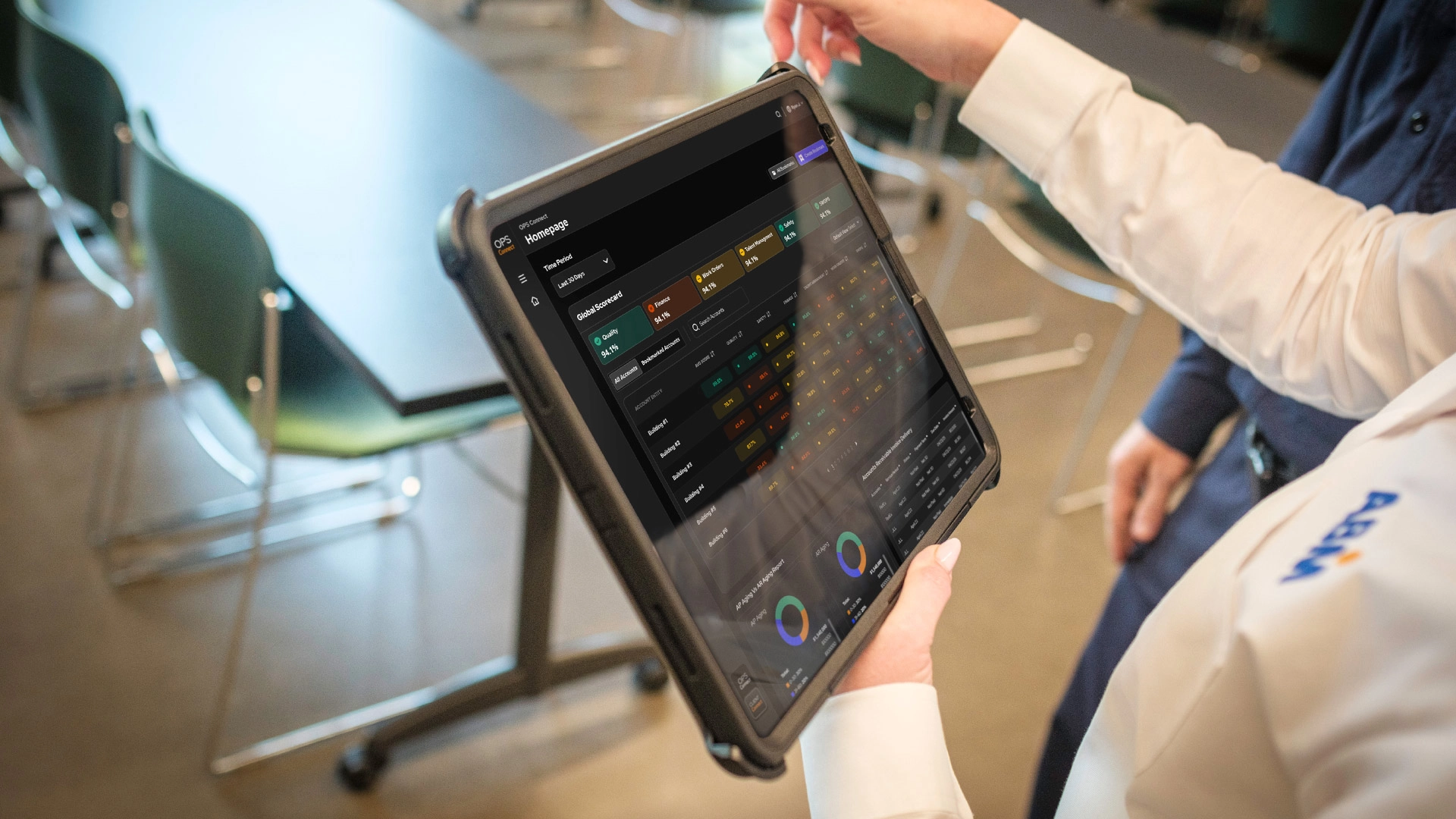
You can’t manage what you can’t measure. Tools like ABM ConnectTM collect and analyze data to help ensure that documented standards are consistently implemented in the field. This platform creates accountability and provides evidence that sustainability practices are being followed as intended. - Continuous improvement -
Operational sustainability is not a one-time achievement. The most effective organizations use audits, inspections, reporting, and stakeholder feedback to identify opportunities for improvement and refine processes over time.
Proof, not promises: How ABM validates its claims
Sustainability leadership increasingly depends on what can be verified, not just what is stated. This year, ABM's greenhouse gas inventory was third-party verified for the first time, one of several proof points behind the latest sustainability report. Rather than positioning that report as an end in itself, ABM treats it as evidence of an operating model: a way of showing, with independent backing, that its sustainability commitments are matched by daily practice.
The clearest example of this operating model is ABM’s achievement of ISSA's Cleaning Industry Management Standard Green Building and Sustainability Certification with Honors (CIMS Green Building + Sustainability Certification with Honors). ABM is the first company to achieve this level of the certification.
The certification process involved more than a year of preparation focused on operational alignment, documentation, workforce training, and process standardization. Approximately 50 to 60 locations were evaluated across multiple markets, supported by 38 hours of document review and 30 days of onsite assessments.
"The biggest impact for us is the ability to deliver consistent, high-quality service across our entire footprint," said Adam Klotch, Vice President of Operations Support & Client Success at ABM.
Understanding the certification
It's easy to hear “certification with honors” and assume the whole thing is an environmental credential. It isn't, and getting this right matters, because the structure is exactly what makes the sustainability claims credible in the first place.
CIMS Green Building + Sustainability is built in layers:
- The core standard (its five foundational sections: Quality System, Service Delivery, Human Resources, Health, Safety and Environmental Stewardship, and Management Commitment) is a cleaning and facility management standard. It covers documented SOPs, quality management, workforce training, safety compliance, and business continuity planning. A baseline environmental policy lives here too, well before any green-specific criteria apply.
- Green Building (CIMS-GB) adds the specialized environmental layer to cleaning: certified green products, high-performance equipment, and waste and recycling programs, benchmarked against thresholds like 75% of annual purchases meeting Green Seal, UL EcoLogo, or EPA Safer Choice standards.
- The Sustainability chapter requires full Green Building compliance for its environmental component, then adds social equity and governance criteria: specific, documented requirements such as fair-wage attestations, anti-discrimination and anti-trafficking policies, and climate-risk and resilience planning, distinct from cleaning operations but certified alongside them.
- The cleaning and facility management foundation isn't a footnote to sustainability. It's the reason sustainability can be independently verified at all: an assessor can only validate environmental, social, and governance claims because the underlying operational systems are documented, consistent, and auditable in the first place.
A new definition of sustainability leadership
The built environment is responsible for nearly 40% of global energy-related carbon emissions, making facility operations one of the most important areas of influence for organizations pursuing sustainability goals.
Organizations that succeed will be those that create operational frameworks capable of delivering consistent outcomes at scale. That means moving beyond sustainability as a reporting exercise and treating it as an operating model.
For facility leaders, the path forward is clear. Sustainability requires standardized processes, trained teams, measurable accountability, and a commitment to continuous improvement. It requires operational discipline.
Explore more about sustainability at ABM.
Explore what operational sustainability looks like at enterprise scale.



.jpg)


%20(1).webp)

.webp)