How AI is changing the riskiest parts of facility jobs

.svg)
Key Takeaways
- Overexertion from lifting, pushing, and pulling is the top cause of serious workplace injury, costing $13.7 billion annually.
- Autonomous scrubbers tied to water sensors reduce slip-and-fall risk overnight, when no facility staff are on site.
- ABM's LaGuardia Terminal B pilot deployed a four-legged inspection robot, one of the first in a U.S. airport terminal.
Transcript
ABM's What's Possible expert panel series recently hosted a conversation about AI and the future of facility services with Kayla Oliver, Head of Products, Partnerships, and Innovation, and Bob Clark, who leads Client Experience and Operations Support. The first three parts of this recap series covered process, demand-based operations, and data readiness.
In this final installment, we look at the intersection between artificial intelligence and the physical environment: the robots now working alongside facility teams. Robots are great for headlines, but the reasons to deploy them have little to do with novelty.
The tasks robots handle best are, in many cases, the tasks most likely to hurt the people doing them. "We have to protect our employees. We have to protect our clients," Clarke said.
The riskiest work is the most repetitive work
Injuries in facility maintenance often come from the most mundane tasks. Data from Liberty Mutual shows that overexertion involving outside sources, meaning lifting, pushing, pulling, and carrying objects, remains the top cause of serious workplace injury, accounting for $13.7 billion in annual costs.
Vacuuming, mopping, and lifting are among the main culprits. Frontline workers are repeating the same motion every shift. "When you think about vacuuming, there is real potential for injury," Clarke said. "So how can robotics reduce those repetitive motions?"
Oliver also noted that waste management causes injuries. "When you think about trash cans, you have no idea how much the bag weighs," she said. "If you are pulling a bag that is unexpectedly overfilled, especially in cafeterias where things can be wet and heavy without a lot of volume, people blow out their backs. That is not good for our team members, and it is not good for workers' compensation."
Robotic trash handling is not ready yet, by her own account, and it will take a fair amount of innovation for them to catch up. “Robots are designed differently than humans. They move differently," Oliver said. "So we may need trash cans to look different in the future. Maybe they are lower, maybe they are wider, so a robotic arm can grab them while staying balanced."
Spills, floods, and the hours when nobody is there
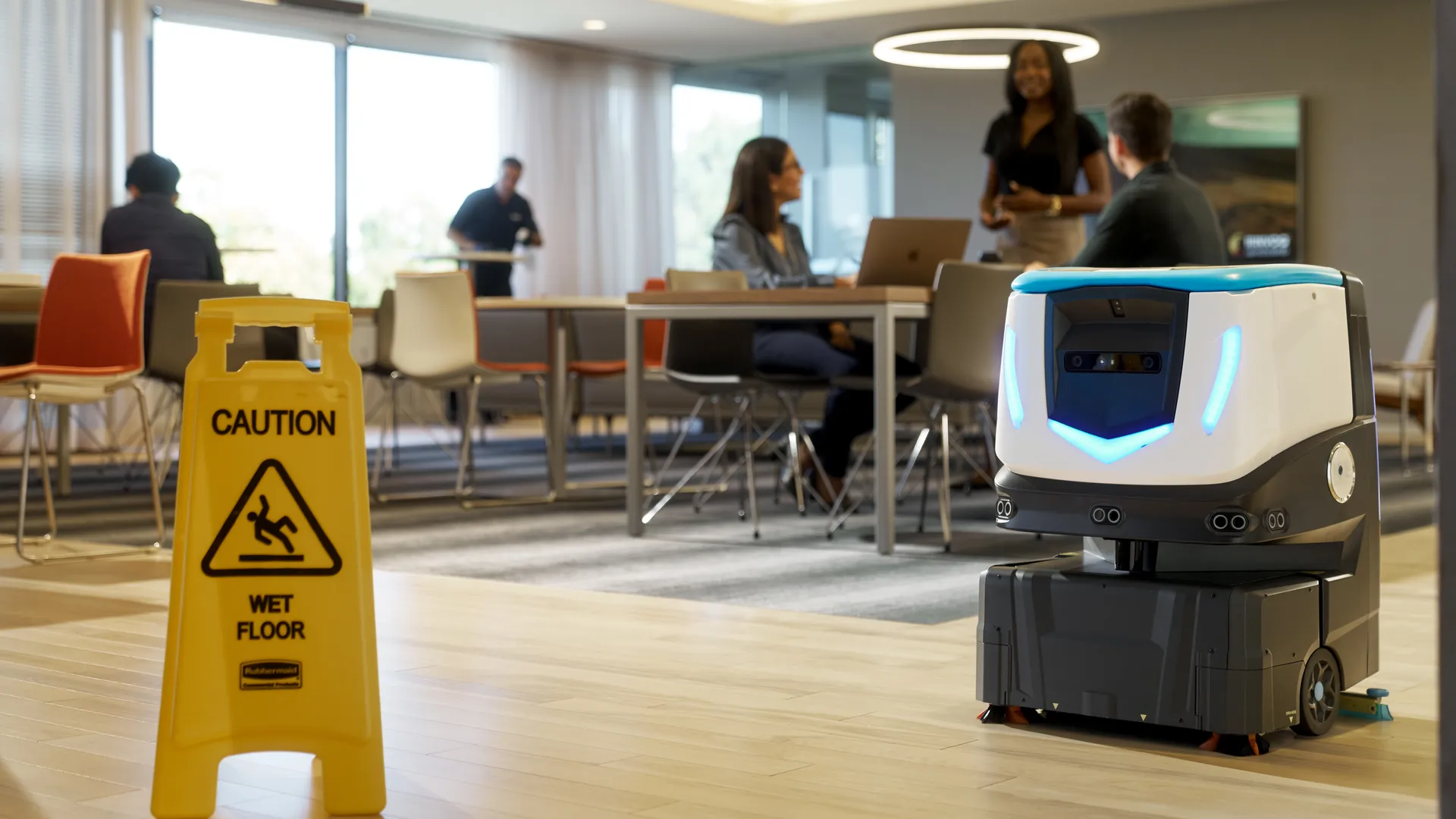
Slip-and-fall risk is another problem that robots can solve. Clarke described a conversation with an oil and gas client whose older buildings have recurring flood issues. The solution: tie water-detecting sensors to an autonomous scrubber that responds automatically.
"Historically, our staff comes in from 5 p.m. to 1 a.m. After that, there is nobody there. Something happens overnight, and it is not discovered until the next morning," Clarke said. "Now you have a real-time deployment with an autonomous scrubber. It is not going to be perfect, because the scrubber has only so much capacity before it has to go back and dump the water. But that risk mitigation piece is critical."
The machines have improved on the same front. Newer scrubbers are strong on water reclamation, picking up what they put down. "Now you have reduced your general liability risk from a slip-and-fall standpoint, and you have protected your employees," Clarke said.
Not every safety application needs a physical robot; AI can still improve safety digitally. Oliver pointed to predictive alerts built from weather and past incident patterns that remind a manager to put out wet floor signs before a problem starts. "It sounds small, but we all have a million things to do in a day, and a safety activity like that should be the number one priority," she said.
One robot, many inspections
Oliver described where robotics is headed: away from machines built for a single task and toward hardware that can learn several.
"Today, that looks like the robot dog. You can teach it many different skills, all around inspection," she said. "Are the water filters out? Is the air quality where it should be? Is there any water on the ground?"
That capability is now in the field. In July, ABM launched a robotics pilot at LaGuardia Terminal B, pairing autonomous scrubbers and vacuums with a four-legged inspection robot, one of the first robotic dogs deployed in a U.S. airport terminal. Anjali Bivek, ABM's Senior Manager of Innovation, described the kind of work it takes on.
"The dog is patrolling the floor and sees liquid on the carpet. It is processing the images it sees and using AI to identify that this is a problem, then it sends an alert to someone on our team," Bivek said.
"The team member can see the image and confirm it really is a spill, not just a reflection from glass. Once they confirm it, they can send a robot or a porter to clean it up. It does not sound exciting, but that is a way of minimizing someone getting hurt quickly."
That is work that would otherwise send a technician into a mechanical space on a fixed schedule, whether or not anything needed attention.
Start with the job, not the robot
Oliver's caution applies here as much as anywhere in the series: "The use case that will drive the most value is very specific to the facility." A plant, an airport, and an office will each have different answers.
Technology is 20% of the battle, and people and process are the other 80%. The facilities that get the most from robotics will not be the ones with the most impressive machines. They will be the ones that started with the question Oliver and Clarke kept asking: which parts of this job are hurting our people, and what would it take to change that?






%20(1).webp)
.webp)